
KSh20,000.00 Original price was: KSh20,000.00.KSh17,500.00Current price is: KSh17,500.00.
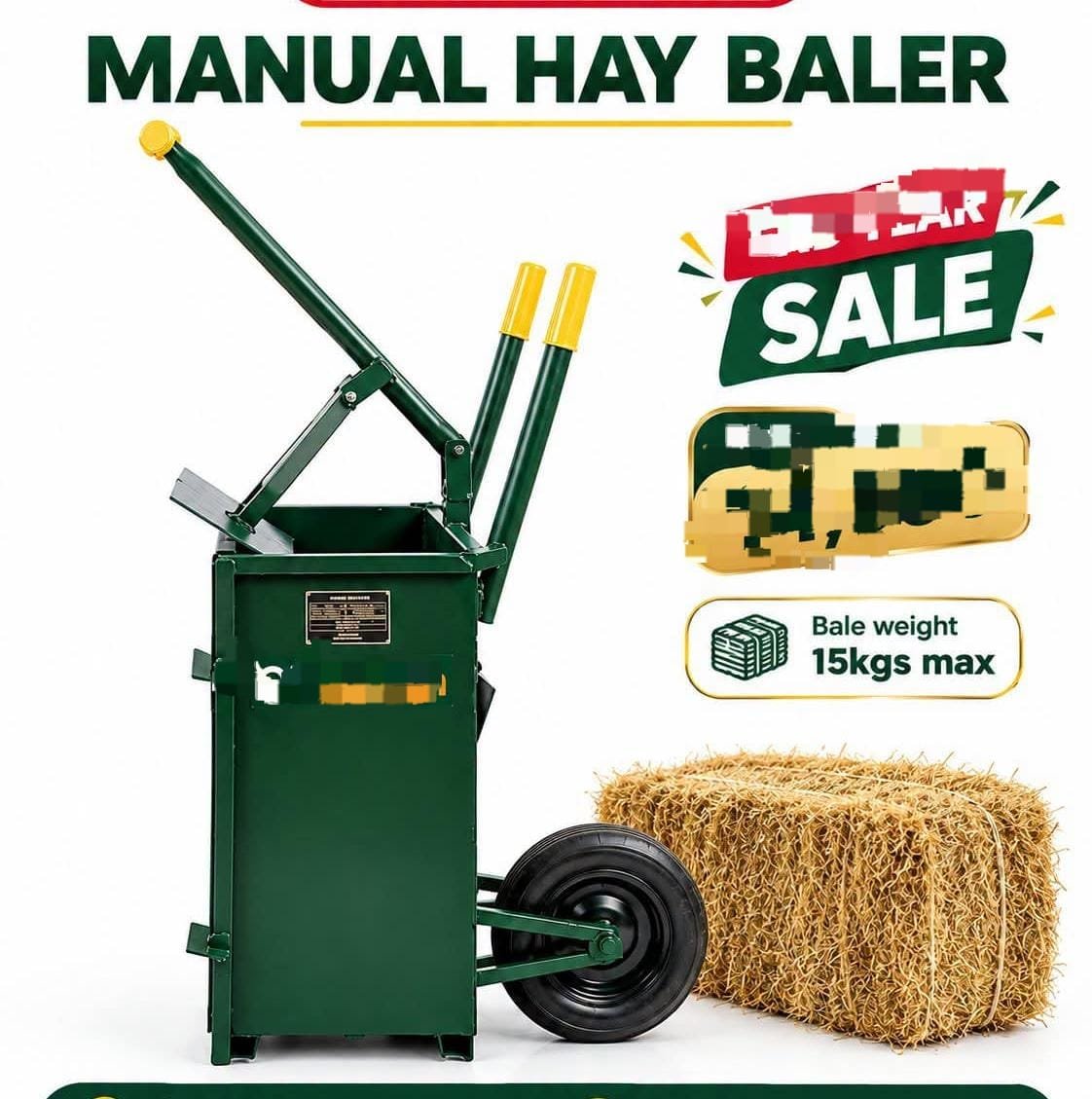
15kg Bale Capacity: Designed for producing manageable hay bales of approximately 15kg, depending on the forage and compression.
Manual Operation: Offers a simple hay baling solution without electricity for fully manual models.
Efficient Hay Compression: Compresses loose hay into compact bales for easier handling and storage.
Easy Transportation: Helps farmers bundle hay for convenient movement and distribution.
Livestock Feed Storage: Ideal for preparing hay for cattle, goats, sheep, and other livestock.
Suitable for Small Farms: A practical solution for smallholder farmers and small-scale hay producers.
Improved Farm Organization: Helps keep harvested hay neatly bundled and organized for storage or sale.

The Manual Hay Baler 15kg is a practical agricultural machine designed to help farmers compress loose hay and other suitable dry forage into compact, manageable bales. It provides a simple, manually operated solution for collecting, organizing, storing, and transporting hay, making it useful for livestock farmers, smallholder farmers, and agricultural businesses.
Hay is an important source of roughage for livestock such as cattle, goats, and sheep. However, loose hay can occupy considerable storage space and may be difficult to handle during transportation and feeding. A manual hay baler helps address these challenges by compressing harvested hay into more organized bundles that are easier to stack, move, and store.
The 15kg manual hay baler is intended for farming operations that need a straightforward way to prepare hay bales without necessarily relying on an electrically powered or tractor-driven baling machine. Its manual operating design can be particularly useful for small-scale hay production, livestock farms, and locations where access to powered agricultural machinery is limited.
Whether you produce hay for your own livestock or prepare forage for local sale, a manual hay baler can help improve hay handling and make everyday farm operations more organized.
Note: The 15kg designation is treated as the intended approximate bale weight. Actual bale weight will depend on the machine’s design, the type and moisture content of the material, and how firmly it is compressed.
The manual hay baler is designed to compress hay through a hand-operated or manually actuated mechanism, depending on the model. This provides an alternative to larger powered baling machines for farms that need a simple hay compression solution.
Manual operation can be beneficial in rural settings, small farms, and areas where electricity or tractor-powered equipment is not readily available. The effort required to operate the baler will depend on its mechanism, the quantity of material loaded, and the required compression level.
The machine is associated with a 15kg bale size, making it suitable for operations that prefer hay bundles of a manageable weight.
Bales of this approximate size can be easier to handle during storage, transport, and distribution than large, loosely packed quantities of hay. However, the actual weight may vary according to the forage type, moisture content, density, and compression method.
For consistent results, confirm the manufacturer’s recommended bale dimensions, target weight, and maximum loading capacity before purchasing.
Loose hay can be bulky and inconvenient to store. The manual hay baler compresses suitable forage into compact bundles, helping reduce its volume and make it easier to organize.
Compressed hay bales can be stacked more conveniently when they are uniform in shape and properly secured. This can help farmers use available storage space more efficiently and simplify movement between the harvesting area and storage facility.
The final bale density and shape depend on the baler’s chamber design, compression mechanism, and operating technique.
A manual hay baler is a practical option for farmers who produce hay on a relatively small scale or do not require the output of a large mechanized baler.
It can help organize hay preparation after harvesting and drying, allowing farmers to package suitable forage into manageable bundles. The number of bales that can be produced in a day will depend on the machine’s design, operator experience, forage condition, and available working time.
Baling loose hay makes it easier to arrange forage in designated storage areas and prepare it for transportation.
Compact hay bales can be stacked and moved more conveniently than loose forage, provided the bales are properly tied and the storage area is suitable. Organized storage can also help farmers manage available feed supplies and make distribution more systematic.
Hay must be sufficiently dry before baling and storage to reduce the risk of heating, mould growth, and spoilage.
The manual hay baler can support farmers who harvest and preserve hay for livestock feeding. It provides a way to package suitable dry forage into bundles that can be stored and distributed when needed.
Potential users include dairy farmers, cattle ranchers, goat farmers, sheep farmers, and other livestock keepers who prepare their own hay supplies.
The baler does not improve the nutritional quality of poor forage; harvesting at the appropriate stage, drying correctly, and storing hay properly remain important for feed quality.
Reduced hay volume: Compresses loose forage into more compact bundles for organized storage.
Convenient bale handling: Helps produce manageable bales for stacking, moving, and distributing.
No engine required for manual models: Offers a baling option without a motor or tractor drive, depending on the product configuration.
Lower equipment complexity: A manual system may have fewer powered components to maintain than a motorized baler.
Improved farm organization: Helps farmers organize harvested hay into clearly defined bundles.
Support for livestock feeding: Makes suitable dry forage easier to store and manage for future feeding needs.
Potential for small-scale hay sales: Uniformly prepared bales may be convenient for handling and selling hay locally, subject to market preferences and actual bale weight.
Suitable for smallholder farming: Provides an alternative to larger machinery for operations with modest baling requirements.
Dairy farmers can use a manual hay baler to prepare suitable dry forage for storage and later use in cattle feeding programs. Well-preserved hay can contribute to a balanced feeding plan when combined with other feeds as required.
Beef cattle producers may use the baler to package hay harvested from suitable forage crops. Compact bales can make it easier to organize feed supplies and move forage around the farm.
Farmers raising goats and sheep can use manageable hay bales to organize dry forage for routine feeding. The suitability of the forage depends on its plant species, quality, and the animals’ nutritional needs.
Small-scale hay producers can use a manual baler to compress harvested and properly dried forage before storing it in a suitable facility.
Agricultural businesses that prepare hay for local sale or distribution may use a manual baler to create convenient packages, provided the resulting bale dimensions and weights meet customer requirements.
A manually operated hay baler may be appropriate for farming locations where powered machinery is unavailable, provided the design can be operated safely and efficiently by hand.
| Specification | Details |
|---|---|
| Product name | Manual Hay Baler |
| Intended bale weight | Approximately 15kg, subject to model and material conditions |
| Equipment type | Manual agricultural baling machine |
| Primary function | Compressing suitable hay and dry forage into bales |
| Operating method | Manual; confirm the mechanism with the supplier |
| Power requirement | No electrical power required for a fully manual model |
| Bale dimensions | Confirm with the supplier |
| Baling chamber size | Confirm with the supplier |
| Supported materials | Confirm approved forage types |
| Construction material | Confirm with the supplier |
| Production capacity | Depends on operator and operating conditions |
| Binding system | Confirm whether twine or other binding materials are included |
| Warranty | Confirm with the supplier |
Note: The exact construction, bale dimensions, binding system, and daily output have not been provided. Confirm these specifications with the supplier before purchasing.
The operating procedure varies by design. Always follow the manufacturer’s instructions for loading, compression, releasing, and securing bales.
The actual bale weight depends on the forage type, moisture content, compression force, and chamber dimensions. Weighing sample bales can help determine whether the finished product meets your target weight.
Regular maintenance helps preserve the manual hay baler’s performance and reliability.
Always keep hands and feet away from pinch points and moving compression components. Never attempt to remove jammed material while the mechanism is under pressure.
Hay should be dried to an appropriate moisture level before baling. Baling forage that is too wet can encourage mould growth, heating, spoilage, and, in some conditions, fire hazards.
Store finished bales in a dry, well-ventilated location. Protect them from rain and ground moisture to preserve forage quality during storage.
Use a consistent loading method and compression technique to produce bales of similar size. If a particular weight is required for sale or distribution, weigh sample bales and adjust loading accordingly.
Use binding twine or other securing materials recommended for the baler. Properly secured bales are easier to handle and less likely to loosen during storage or transport.
The Manual Hay Baler 15kg is a practical option for farmers who need to compress hay into manageable bundles without relying on large powered machinery. It can help simplify hay preparation, improve storage organization, and support routine livestock feed management.
For smallholder farms, livestock keepers, and small-scale hay producers, manual baling offers a straightforward way to package suitable dry forage for storage, transport, and distribution. The intended 15kg bale size may be convenient for handling, although actual bale weight will depend on the machine and material being processed.
Before purchasing, consider the expected volume of hay, the physical effort required to operate the machine, the bale size you need, the available storage space, and the condition of the forage you intend to bale. Confirming the machine’s dimensions, construction, and operating method will help determine whether it suits your farm’s requirements.
Fast, reliable delivery to all regions nationwide.
100% genuine and certified products.
Manufacturer-backed warranty on all products.

Reviews
There are no reviews yet.