
KSh74,000.00 Original price was: KSh74,000.00.KSh71,000.00Current price is: KSh71,000.00.
Efficient Particle Separation: Uses vibration to separate materials according to particle size.
Versatile Screening Applications: Suitable for screening compatible powders, granules, grains, seeds, and other solid materials.
Different Mesh Sizes: Screen mesh options may be available to meet specific particle separation requirements.
Improved Processing Efficiency: Helps reduce manual sieving and streamline material preparation.
Consistent Material Grading: Supports more uniform screening when the correct mesh and operating settings are used.
Multiple Industrial Applications: Suitable for agricultural processing, food production, manufacturing, and other compatible industries.
Easy Maintenance: Regular screen cleaning and inspection help maintain reliable performance.

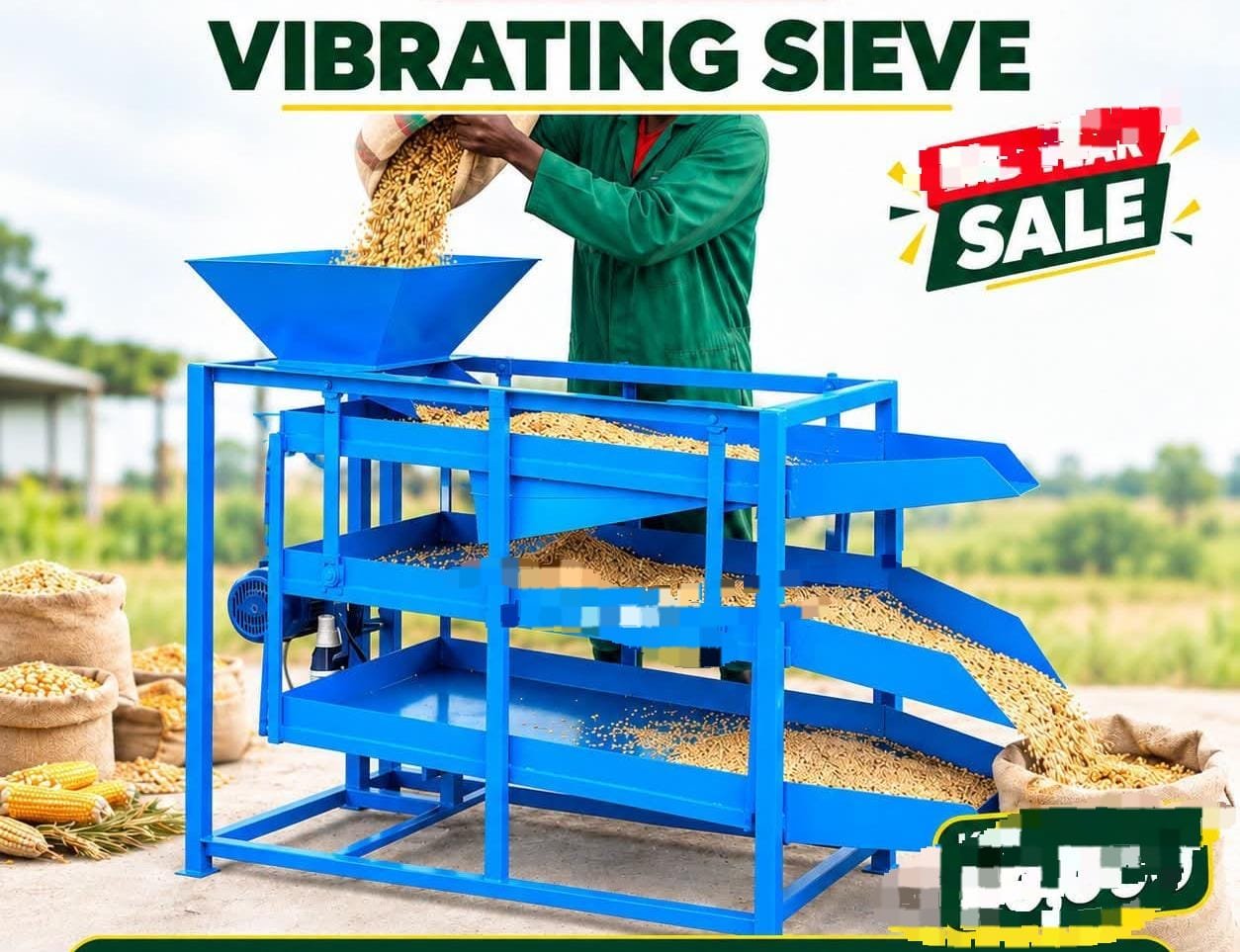
A Vibrating Sieve Machine is a screening and separation device designed to separate materials according to particle size. Using a vibrating screen, the machine helps sift powders, granules, grains, and other compatible materials, allowing smaller particles to pass through the mesh while larger particles or unwanted impurities are retained.
Vibrating sieves are used in agriculture, food processing, manufacturing, mineral processing, and other industries where material screening and particle-size separation are important. By automating the sieving process, this equipment can help reduce manual labour, improve processing efficiency, and support more consistent material preparation.
Depending on the machine’s design, screen mesh size, and number of screening levels, a vibrating sieve may be used for grading materials into different size categories, removing oversized particles, separating unwanted debris, or preparing materials for subsequent production stages.
Whether you operate an agricultural processing business, grain handling facility, food production operation, or industrial processing plant, a vibrating sieve machine can be a useful addition to your material handling and processing equipment.
A vibrating sieve uses controlled vibration to move material across a screening surface. This movement helps distribute the material across the mesh and allows particles of the appropriate size to pass through the openings.
The vibration mechanism helps make screening more efficient than relying entirely on manual sifting. Actual performance depends on the machine’s design, vibration characteristics, screen area, material properties, and operating conditions.
The main function of a vibrating sieve is to separate compatible materials according to particle size.
The screen mesh determines which particles can pass through and which remain on the screen. Selecting the correct mesh size is essential for achieving the desired separation results.
Potential screening tasks include:
The achievable separation accuracy depends on particle shape, moisture content, material flow, mesh specifications, and machine configuration.
A vibrating sieve can be used with a range of materials when the screen, construction, and operating setup are appropriate.
Potential applications include:
Agricultural processing: Screening suitable grains, seeds, and other agricultural materials.
Food processing: Sifting compatible powders, flour-like materials, and food ingredients when the machine meets applicable food-contact and hygiene requirements.
Powder processing: Separating fine and coarse particles in suitable powdered materials.
Manufacturing: Screening compatible granules and raw materials before production or packaging.
Mineral and industrial processing: Classifying suitable solid materials according to particle size when the machine is designed for the intended material and working conditions.
Not every vibrating sieve is suitable for every material. Moisture, abrasiveness, chemical properties, hygiene requirements, and particle size should be considered before selecting a machine.
Screen mesh size is an important factor in determining the performance and suitability of a vibrating sieve.
A finer mesh may be used when smaller particles need to be separated, while a larger mesh opening allows bigger particles to pass through. The appropriate mesh depends on the desired output and the characteristics of the material being screened.
Depending on the model, the machine may support interchangeable screens or different mesh configurations. Confirm the available mesh sizes and replacement screen options with the supplier before purchasing.
Manual sieving can become time-consuming when processing large quantities of material. A vibrating sieve helps mechanize the screening process, potentially reducing manual effort and improving the flow of materials through a production operation.
For businesses that regularly handle powders, granules, grains, or other compatible solids, mechanized screening can help streamline preparation before mixing, packaging, storage, or further processing.
Actual throughput depends on the machine’s dimensions, material characteristics, screen openings, and operating conditions.
Screening helps remove particles that fall outside the desired size range. This can support more consistent material preparation and make subsequent processing stages easier to manage.
For example, a vibrating sieve may help remove coarse particles from a powdered product or grade suitable agricultural materials into different size categories. The final result depends on the incoming material, screen selection, and machine operation.
A vibrating sieve does not automatically guarantee that material is free from every type of contamination. Additional cleaning, sorting, or quality-control equipment may be necessary depending on the application.
Vibrating sieves are available in various sizes and designs to meet different processing requirements. Depending on its configuration, a machine may be suitable for small processing businesses, agricultural enterprises, workshops, or larger production facilities.
Before choosing a model, consider your required capacity, material type, target particle size, screen area, and the number of separation stages needed.
Efficient particle separation: Helps separate materials according to size through controlled screening.
Reduced manual labour: Mechanizes the sieving process and reduces dependence on hand screening.
Consistent material grading: Supports more uniform screening results when the correct mesh and operating settings are used.
Versatile applications: Can process different compatible powders, granules, grains, and solid materials, depending on machine design.
Improved workflow: Helps prepare materials for mixing, further processing, storage, or packaging.
Flexible screening options: Different mesh sizes may be available to suit a variety of separation requirements.
Support for production quality: Helps remove oversized particles and classify materials as part of a broader quality-control process.
Practical processing equipment: Can be incorporated into agricultural, commercial, and industrial processing setups.
In agricultural processing operations, a suitable vibrating sieve can help screen compatible grains, seeds, and other dry materials. Screening may support size grading or the removal of certain unwanted particles.
The machine’s suitability for a specific grain or seed depends on screen design, material condition, and the required separation outcome.
A vibrating sieve designed for the intended application may be used to sift compatible powders and flour-like ingredients. It can help separate coarse particles and reduce unwanted variations in particle size.
For food applications, confirm that the machine’s contact surfaces, screen materials, and cleaning procedures meet the applicable food-processing requirements.
Manufacturing and processing businesses may use vibrating sieves to separate compatible granules into different size ranges. This can help prepare materials for production, blending, or packaging.
Certain vibrating sieve models are designed for screening solid industrial materials, including suitable powders, pellets, and granules. Material compatibility and required operating conditions should be assessed before use.
A vibrating sieve can be positioned before other processing equipment to help classify incoming material or remove particles that do not meet the required size range. It may form part of a wider material preparation and quality-control system.
| Specification | Details |
|---|---|
| Product name | Vibrating Sieve Machine |
| Equipment type | Vibrating screening and separation equipment |
| Primary function | Particle-size separation and material screening |
| Vibration mechanism | Confirm with the supplier |
| Screen mesh size | Confirm available options |
| Number of screening levels | Confirm with the supplier |
| Processing capacity | Confirm with the supplier |
| Motor power | Confirm with the supplier |
| Power supply requirements | Confirm with the supplier |
| Screen material | Confirm with the supplier |
| Machine construction material | Confirm with the supplier |
| Suitable material types | Depends on machine configuration |
| Dimensions | Confirm with the supplier |
| Warranty | Confirm with the supplier |
Note: Specific details such as motor power, hourly capacity, mesh sizes, construction materials, and number of screening levels have not been provided. Confirm these specifications with the supplier before purchase.
Selecting the appropriate vibrating sieve requires understanding the material you want to process and the results you need.
Material type: Confirm that the machine is designed for your material, especially if it is wet, sticky, abrasive, chemically reactive, or intended for food production.
Screen mesh size: Choose an opening size suited to the target particle size and desired separation.
Processing capacity: Determine how many kilograms per hour or per batch you need to screen, and compare this requirement with the machine’s rated performance.
Screening levels: If you need to separate material into several size categories, check whether a multi-level screening configuration is available.
Cleaning requirements: Consider how easily the screen and material-contact surfaces can be cleaned, particularly when processing food or products that require strict hygiene.
Power requirements: Verify the machine’s motor rating, voltage, phase, and electrical installation requirements.
Maintenance and spare parts: Check screen replacement options, availability of compatible components, and recommended servicing intervals.
Choosing a machine that matches your material and production needs can help improve screening performance and reduce operational difficulties.
Correct operation and routine maintenance help ensure that a vibrating sieve performs reliably.
For food or feed applications, establish suitable cleaning procedures to reduce the risk of cross-contamination between materials.
A vibrating sieve machine offers a practical solution for businesses that need to separate particles, grade materials, or sift compatible powders and granules. Its vibrating screening mechanism can help automate material separation, reduce manual sifting, and support a more organized processing workflow.
For agricultural processors, manufacturers, and other businesses handling solid materials, the right vibrating sieve can become an important part of the production process. Its performance will depend on selecting an appropriate machine design, screen mesh, and operating setup for the intended material.
Before purchasing, confirm the machine’s processing capacity, mesh options, motor specifications, construction materials, and maintenance requirements. This helps ensure that the equipment is suitable for your specific screening application.
Fast, reliable delivery to all regions nationwide.
100% genuine and certified products.
Manufacturer-backed warranty on all products.


Reviews
There are no reviews yet.